
An exploration of nature, architecture, and the quiet power of light.
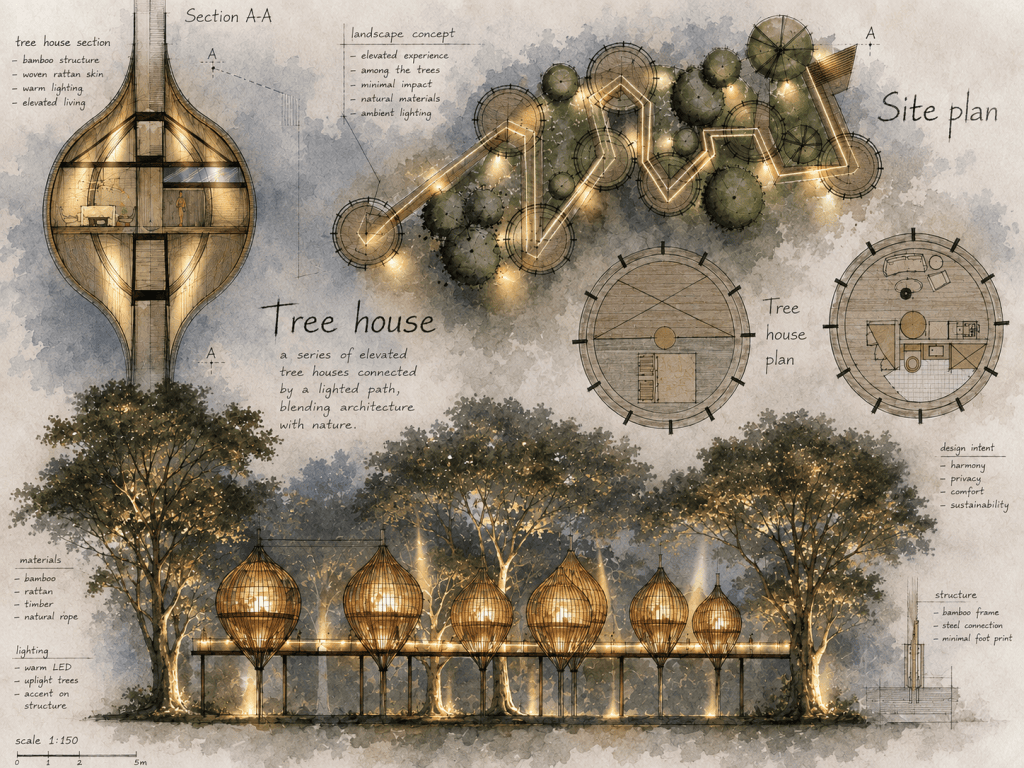
Forests shape light through leaves, movement, and shadow. As a lighting designer, I wondered: what would happen if architecture followed that same rhythm?
What if the forest becomes the architecture?
What if, instead of clearing the land to make space for buildings, we allowed the buildings to find their place within the forest?
Imagine houses wrapping around trees like nests. Small spaces suspended among branches, connected by bridges that gently follow the landscape.
Architecture would become part of the forest experience. And lighting would have to approach the space differently, too.
When the Canopy Becomes Part of the Light
One of my favourite things about natural light is that it never feels completely predictable.
Sunlight passes through the canopy, creating patterns on the ground that change throughout the day. Some areas are bright, others remain in shadow, and the contrast gives the forest its depth.
Why should that experience disappear after sunset?
In this concept, I imagine light discreetly integrated among the trees, allowing leaves and branches to filter and shape it.
A soft glow through the foliage. A branch briefly revealed. A pool of warm light falling across a suspended walkway.
The intention isn’t to recreate daylight at night. It’s to translate the feeling of being beneath the canopy into a quieter, more intimate experience.
I don’t want light to take attention away from the forest. I want it to help us experience the forest differently.
A Bridge That Connects More Than Spaces
The suspended bridges are probably my favourite part of this concept. They aren’t simply connections between treehouses. They become part of the journey.
I imagine walking along a narrow bridge at night, surrounded by the silhouettes of trees.
A subtle line of warm light follows the edge, just enough to understand the path and feel comfortable moving forward. Beyond that line, the forest remains dark.
I believe some of the most powerful lighting experiences happen when we allow darkness to remain part of the composition. It creates depth and gives meaning to the areas we choose to illuminate.
For me, the bridge should feel like a delicate line moving through darkness, not a brightly lit corridor cutting across the landscape.
Reveal the route. Preserve the mystery.
The Warmth of a Nest
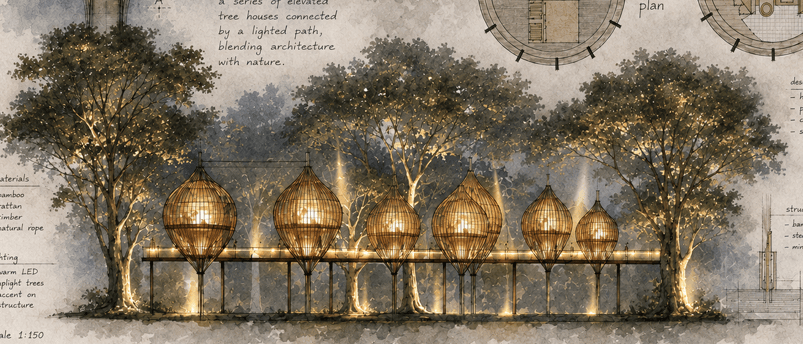
Looking at the treehouses themselves, I imagine them glowing softly from within.
Bamboo and woven rattan offer an opportunity to let light pass through the building skin, revealing its texture. The houses could become gentle lanterns among the trees.
I love the contrast between a softly illuminated interior and the darkness outside. From a distance, the treehouses would appear as small pockets of warmth suspended in the forest.
That warmth creates a sense of shelter, privacy, and belonging without overwhelming the surrounding landscape.
Let the Landscape Lead
The same thinking applies to the ground beneath the trees.
The terrain changes, roots emerge, and materials shift. Lighting should help people read those characteristics.
If a pathway curves, let the light follow its movement. If the ground changes level, allow subtle variations in brightness to reveal that transition.
Where a roof follows the surrounding topography, carefully selected moments of light could reveal its form without tracing every edge.
Read the land first. Then let light trace it.
Knowing When Not to Use Light
Sometimes the most thoughtful decision is to leave an area dark.
We often measure a lighting design by what it reveals, but rarely by what it chooses to preserve. In a forest, darkness isn’t empty space. It’s part of the environment.
The illustration explores atmosphere. A developed lighting scheme would need to test which effects to retain, reduce, or remove in response to the site’s ecology.
That includes the extensive tree lighting shown here. The visual effect is a starting point for discussion, not a specification for installation.
I would approach the concept with warm, low-intensity lighting, precise optical control, appropriate dimming, and minimal spill beyond the areas people actually use.
Even the way luminaires are fixed to trees matters. The installation should respect their growth and avoid unnecessary damage.
A beautiful visual concept is only successful if it can coexist responsibly with its surroundings.
Belonging, Rather Than Standing Apart
When I look at this illustration, I see the possibility of a different relationship between architecture and the natural world. One where buildings don’t need to dominate the landscape.
Materials, structures, and light work together to create an experience connected to its setting. The atmosphere comes from how carefully light is placed.
As lighting designers, we can change how people experience a space after dark. But perhaps our greatest opportunity is knowing when to intervene and when to let nature remain the main character.
It’s about giving people just enough light to discover the beauty that was already there.
Where would you place light in this landscape—and where would you leave darkness?
Conceptual design reflection by Nihal
The Glow Recipe | Architecture, Light & Human Experience

