
When I look at this landscape lighting sketch, my eye moves between small pools of warm light. The steps are visible. A few trees and places to pause become part of the scene. Yet large parts of the landscape are left quiet.
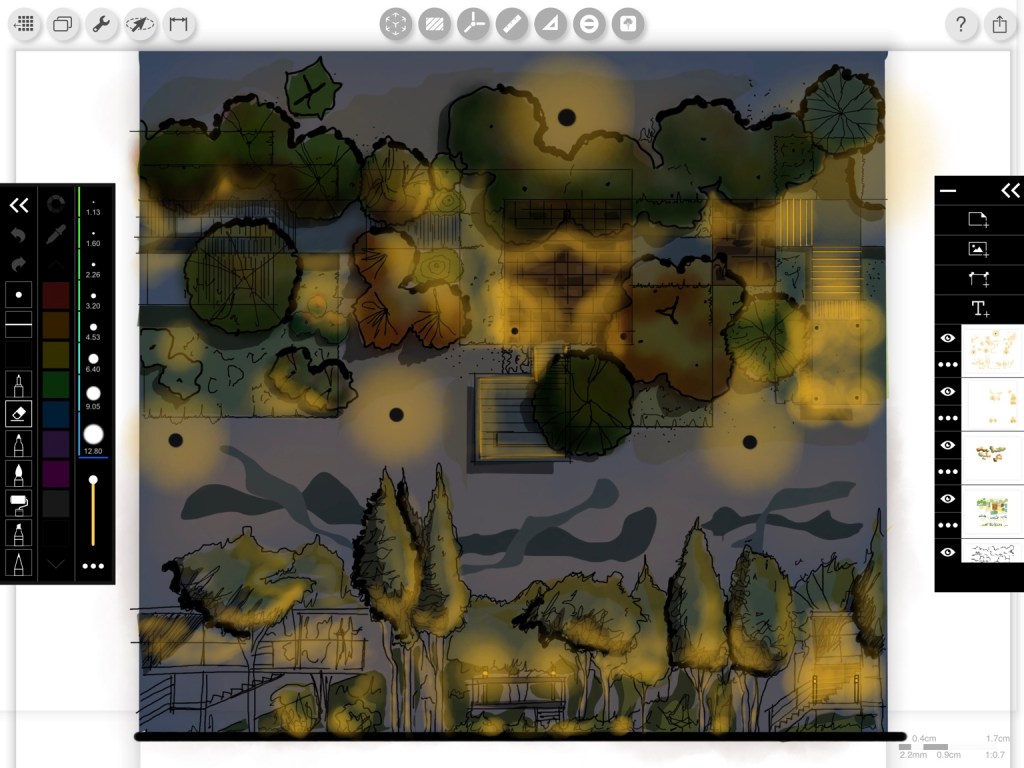
That was the question behind the drawing: what should light help us notice, and what should it leave alone?
Start with the route
In the plan at the top, I gave the steps a stronger presence than the areas around them. I wanted a change in level to read clearly as someone moves through the space. The glow then leads toward a few places to pause, while the darker planting gives the eye a moment to rest. This is a concept drawing, so the final lighting levels and aiming would still need to be tested on site.
The perspective below helps me ask a different question: what will a person actually experience? From that viewpoint, the lit trees and seating become moments along a journey rather than a list of features to illuminate. I would rather let someone discover them in sequence than see the entire garden at once.
Give darkness a job
Before selecting luminaires, I would check the actual routes, mounting positions, beam directions and how much light reaches the surrounding planting. A beautiful glow on paper needs careful aiming and control to work responsibly outdoors. DarkSky International and the Illuminating Engineering Society recommend using outdoor light where it is needed, keeping it targeted and no brighter than necessary, and turning it down or off when it is no longer needed.
For me, the most interesting part of this image is the space between the bright areas. It gives each lit moment a purpose. This is one way I think about the principle that darkness is a design element.
Further reading: Five Principles for Responsible Outdoor Lighting.

